San Fernando’s Anti-Camping Ordinance
The City of San Fernando has taken a balanced approach to addressing homelessness for over three years, prioritizing compassion by providing resources, housing, and support to help those in need find a pathway out of homelessness.
At the same time, enforcing local, state, and federal laws is essential to maintaining a clean and safe community. Since July 15, 2024, the San Fernando Municipal Code has prohibited camping in public spaces, and the City has remained responsive to evolving judicial guidance, including several cases before the United States Supreme Court.
By combining a services-first approach with the enforcement of Ordinance 74-282, when necessary—and ensuring the availability of temporary shelter beds—San Fernando has avoided the large-scale tent cities and encampments that many neighboring jurisdictions are currently facing.
On July 15, 2024, the San Fernando City Council reviewed the City's approach to anti-camping enforcement and approved an update to the Municipal Code. Below is a list of frequently asked questions and answers to clarify the City Council's actions and outline the path forward.
Frequently Asked Questions (FAQ)
What does the San Fernando Municipal Code define as camping?
Sec. 74-280. - Definitions
- "Camp" means to pitch, erect, or occupy camp facilities or encampment or to use camp paraphernalia, or both, for the purpose of, or in a way that facilitates outdoor sheltering for living accommodation purposes or for remaining outdoors overnight.
- "Camp facilities" include, but are not limited to, tents, huts, or other temporary shelters.
- "Camp paraphernalia" means personal property used to facilitate occupancy of an area and includes, but is not limited to, tarpaulins, cots, beds, sleeping bags, hammocks or non-City designated cooking facilities, blankets, sheets, pillows, luggage, backpacks, cookware, cooking equipment, kitchen utilities, and similar equipment.
- "Encampment means" one or more temporary, makeshift, or hand-built structures not intended for long-term continuous occupancy, including tents, that are used to shelter one or more persons or their belongings and that are not authorized by the property owner. Encampment includes any camp paraphernalia and personal property associated with or located in or around the structures or tents.
What is the history of the city's anti-camping ordinance?
On June 28, 2024, the United States Supreme Court published an opinion, City of Grant Pass V. Johnson 72 F. 4th 868 acknowledging that the causes of homelessness are complex and varied. The Court also affirmed that cities should have the authority to use a range of tools to address its challenges, including the ability to enforce criminal penalties when other, less punitive efforts have failed.
What did the San Fernando City Council do on July 15, 2024?
As a result of the 2024 Supreme Court ruling in Grant Pass, the City Council approved an ordinance on July 15, 2024 amending the San Fernando Municipal Code. This amendment added Article VII of Chapter 74 to Prohibit Encampments and Storage of Personal Property in public places within the City limits of San Fernando.
Sec. 74-282 - Enforcement
- Violations of this article may be prosecuted as misdemeanors under article II of chapter 1 or as public nuisances under article III of chapter 1. The enforcement procedures of these articles are in addition to any specific enforcement procedures set forth in this article. Unless otherwise expressly provided, the remedies and penalties provided by this chapter are cumulative to each other, and to the remedies and penalties available under any other provision of this Code and any other laws.
The updated ordinance allows the city to enforce violations as either misdemeanors or public nuisances, offering multiple avenues for legal action. It also permits enforcement under other applicable articles and laws in addition to the specific procedures outlined in this article. The remedies and penalties are cumulative, meaning the city can impose multiple penalties or use different enforcement mechanisms simultaneously to effectively address violations.
Is it illegal to sleep in public spaces?
The Municipal Code's prohibition against camping requires a determination that an individual is using a public space for the purpose of a "living accommodation." There is no prohibition against simply sleeping in a public place.
How does the updated ordinance change the city's approach to addressing camping in public spaces?
The updated ordinance allows police to consider camp facilities, which may include, but are not limited to, tents, huts, or other temporary shelters, as well as camp paraphernalia and personal property associated with or located in or around these structures. A person may be in violation of the anti-camping ordinance if they have erected or maintained a camp facility in a public space for their own living accommodation. To determine whether this is the case, a police officer will evaluate the totality of the circumstances, including the presence of tents, huts, temporary shelters, or other prohibited items.
Can the city arrest people for sleeping in cars?
The ruling in the Grants Pass case does not address the issue of sleeping in vehicles.
What other ordinances does the Municipal Code include regarding use of public spaces?
What is the San Fernando's Police Department's approach to enforcing the prohibition of camping in public spaces?
The Supreme Court's decision in the Grants Pass case reaffirms the authority of local governments to establish and enforce laws regulating behavior within their jurisdictions, including anti-camping ordinances.
The Court emphasized that cities should prioritize offering services and alternatives to individuals camping in public spaces before pursuing criminal enforcement.
The San Fernando Police Department has been committed to enforcing the anti-camping ordinance legally and in accordance with case law and best practices. This means giving warnings and making referrals to shelters and other outreach services prior to issuing citations for camping.
What happens after someone is cited or arrested for violation of the anti-camping ordinance?
All misdemeanor citations and arrests are referred to the Los Angeles District Attorney's Office, where a prosecutor independently reviews the case to determine whether to file criminal charges. Charges are based on a thorough review of all available evidence indicating that an individual has established a camp facility for use as a living accommodation. This evidence may include police reports, body camera footage, photographs, and the individual's prior contacts with the San Fernando Police Department for the same offense.
What do I do if I see someone in crisis from drugs, alcohol, or mental health?
If you believe someone is experiencing a medical emergency or poses an immediate threat to public safety, call 911.
For non-urgent requests or concerns, call the non-emergency police number at (818) 898-1267 or contact the San Fernando Outreach Line at (818) 898-1210. You can also email homeless@sanfernando.gov or request outreach through the "MySanFernando" app via the Homelessness Outreach Tab.
Guidelines for Letter of Agency
These guidelines have been developed to assist property owners in managing unauthorized access to their property and to facilitate the legal process for addressing reoccurring trespassing issues involving known encampments or unauthorized access by individual. Under Section 602(o) of the California Penal Code, a Letter of Agency may be utilized for commercial and private properties.
Guidelines subject to change without prior notice.
Properties that qualify to use a Letter of Agency
- Properties which the San Fernando Police Department has received and documented four "calls for service" regarding trespassing within a 12 month period.
- Documented evidence of trespassing violation may include, but are not limited to, citations, arrests, crime reports, incident reports, visual observations and verification by a law enforcement officer.
- Evidence of trespassing must establish that a trespass had occurred or is currently occurring on the property of agency.
- Undeveloped land or vacant commercial properties that are closed to the general public at all times.
- Commercial properties that are closed during designated hours.
- Vacant residential properties, limited to secured single-family residences.
- Private residential communities, including Homeowner's Associations, condominiums, and apartment complexes, that are not open to the general public.
- A recorded nuisance property that considerably affects the quality of life in the surrounding neighborhood.
- The Letter of Agency does not provide for or imply that additional or increased patrol from the San Fernando Police Department will occur for the property listed in the Letter of Agency.
- A Letter of Agency does not automatically result in an individual's arrest. The Officer will assess the legal circumstances and the totality of the circumstances to determine the appropriate enforcement action.
Property Owners Responsibilities
- Provide an updated Letter of Agency that is clearly legible, signed, and on file with the San Fernando Police Department. The Letter of Agency must be renewed every 12 months. Download a Trespass Authorization Arrest (Letter of Agency) form(PDF, 341KB).
- The property must have proper posted signs prohibiting trespassing. For businesses, the sign must also indicate the hours during which the business is closed.
- During regular business hours, the property owner or property agent must sign a private person's arrest form to authorize the arrest of a trespasser on the property.
In addition to these requirements, the property owner or agent may be required to appear in court if a trespasser is arrested on the property.
A Letter of Agency must be completed and returned in person to the San Fernando Police Department, including photographs of the posted signs meeting stipulated legal requirements. The letter must be signed by the property owner or an authorized representative in the presence of a Notary Public. Download a Trespass Authorization Arrest (Letter of Agency) form(PDF, 341KB).
For any questions regarding the Letter of Agency requirements, please contact the San Fernando Police Department at (818) 898-1267.
Letter of Agency Sign Requirements
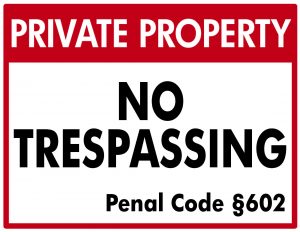
The following is a guideline to assist property owners with the proper wording, placement, and sizing of "No Trespassing" signs, as well as recommended posting locations.
Recommended Signs Size
The sign must be at least 8.5" x 11" in size, with legible font visible from the nearest public street. It should feature at least 1" block letters and be placed in a location that is not easily accessible for damage. It is recommended that signs be placed in a visible location at each driveway and entrance to the property.
Sample Signs
Download and print sample sign 1(PDF, 14KB)

Download and print sample sign 2(PDF, 19KB)
Contact Information
Brian Woodward, Patrol Commander
(818) 898-1258 | BWoodward@sanfernando.gov
Regular Business Hours
Monday through Friday | 9 am to 6 pm